FMR logo people ox logo rsc logo
dep int dev
 
NHQ Logo
 
RMF Logo
 
French Logo
 
Facebook link
Twitter link

Each issue of FMR has a feature theme but about a third of each issue is set aside for ‘non-theme’ articles. We encourage readers to send us written contributions on any aspect of contemporary forced migration.

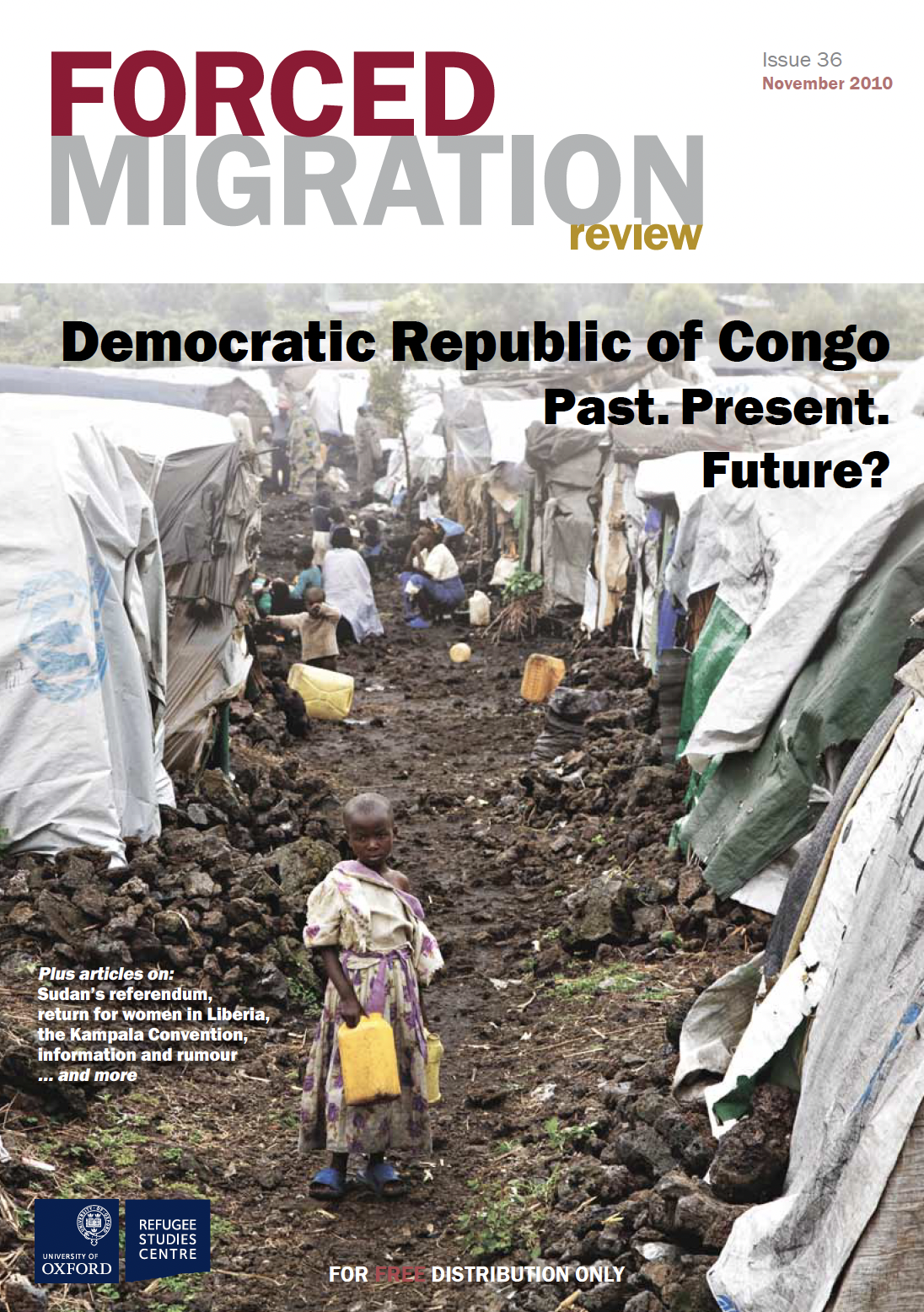
FMR 36 – to be published in November 2010 – will include a feature section on:

Democratic Republic of Congo / Great Lakes

Deadline for submission of articles: 31st May 2010

Since the mid-1990s, millions of Congolese have fled their homes to escape fighting and violence between rebel groups and the government, in a complex conflict which involves and overlaps with conflicts in neighbouring states in the Great Lakes region. As of July 2009, there were an estimated two million people internally displaced in DRC, and over 190,000 refugees inside DRC, mainly from Angola, Rwanda and Burundi. Some 370,000 Congolese have fled their country, and are refugees in neighbouring countries. 

Many Congolese IDPs have not received assistance from international agencies, whose access has been blocked because of insecurity. Tens of thousands have sought shelter in camps and other settlements, as the resident population’s capacity to host IDPs has declined. The situation continues to be plagued by widespread violence and sexual- and gender-based violence (SGBV), recruitment of children into the armed forces, kidnapping, and a culture of abuse within the country’s own security forces. Alongside this lack of protection, government institutions are weak and/or corrupt and there is general impunity for perpetrators of violence. Deplorably weak infrastructure adds to the insecurity to present huge logistical barriers to provision of assistance. 

There is great need for heightened international awareness of and a concerted focus on the causes of violence and displacement in DRC, the consequences, and the potential for resolution and assistance.

 FMR 36, with its feature on DRC and the Great Lakes, will provide a forum for practitioners, advocates, policymakers and researchers to examine the challenges and underlying issues at stake, share experiences, explore initiatives and examples of good practice, and present recommendations for action. It will also present the voices of those most closely affected by conflict and displacement in DRC. Authors from outside the region with experience to bear will also be invited to write. In particular, the FMR Editors are looking for practice- and policy-oriented submissions, reflecting a diverse range of opinions, which address questions such as the following:

  • What are the dimensions of the displacement crisis in and around DRC? What constraints are there to full knowledge and analysis of the crisis?
  • What are the prospects for return or local integration of Congolese refugees in other countries?
  • What role is the Congolese diaspora playing?
  • Given the causes and dynamics of current and potential instability in DRC and the region, what national and regional strategies exist to end the violence?
  • What has been the impact – and what are the limitations – of the Pact on Security, Stability and Development in Africa’s Great Lakes region, which came into force in June 2008?
  • How do global geopolitical factors affect international responses to DRC?
  • What has been the impact – and what are the limitations – of DRC’s 2002 Refugee Law?
  • How have the Guiding Principles on Internal Displacement been incorporated into national laws?
  • How can the rule of law be promoted and supported in DRC and by the surrounding countries that are involved in DRC?
  • How can the international community contribute towards reducing violence, promoting peace and stability, and improving protection provision in the region?
  • What has been the impact of reintegration programmes on local conflicts?
  • Given the appalling levels of SGBV in DRC, how can protection be improved? What has been the impact of the two laws on sexual violence passed in 2006?
  • What measures exist to reduce the incidences of abduction, forced recruitment into the armed forces, and slavery?
  • What particular challenges face unaccompanied displaced children in DRC, and how can they be better protected?
  • How are the government and international agencies tackling the lack of access to basic necessities that most IDPs and vulnerable Congolese are experiencing, particularly in the areas of health, education, water and sanitation, food and livelihoods?
  • How can access to displaced populations be improved and how have international agencies adapted to the reality of reduced humanitarian space?
  • What is the potential role of local NGOs in helping people face this crisis and how far have they been enabled or are they able to do this? How can their capacity be enhanced?
  • Is ‘integration’ working for the UN operation in DRC? What has been the impact of MONUC, the cluster system, the Programme of Expanded Assistance to Returns, the Pooled Fund and other coordination mechanisms?
  • What factors affect the availability of funding for the crises in DRC and the surrounding countries?
  • What are the reasons for, and the potential impact of, the decision of the UN Human Rights Council in March 2008 not to renew the mandate of the Independent Expert on human rights in DRC?


Deadline for submission of articles: 31st May 2010
Maximum length: 2,500 words.
We are particularly keen to reflect the experiences and knowledge of communities and individuals in DRC and the Great Lakes region.

Please email the Editors at fmr@qeh.ox.ac.uk if you are interested in contributing or have suggestions of colleagues or community representatives who may wish to contribute. If you are planning to write, we would be grateful if you would take note of our Guidelines for Contributors at: www.fmreview.org/writing.htm

myspace visitors


return to top of page


Tell others about FMR: