
- April 2026
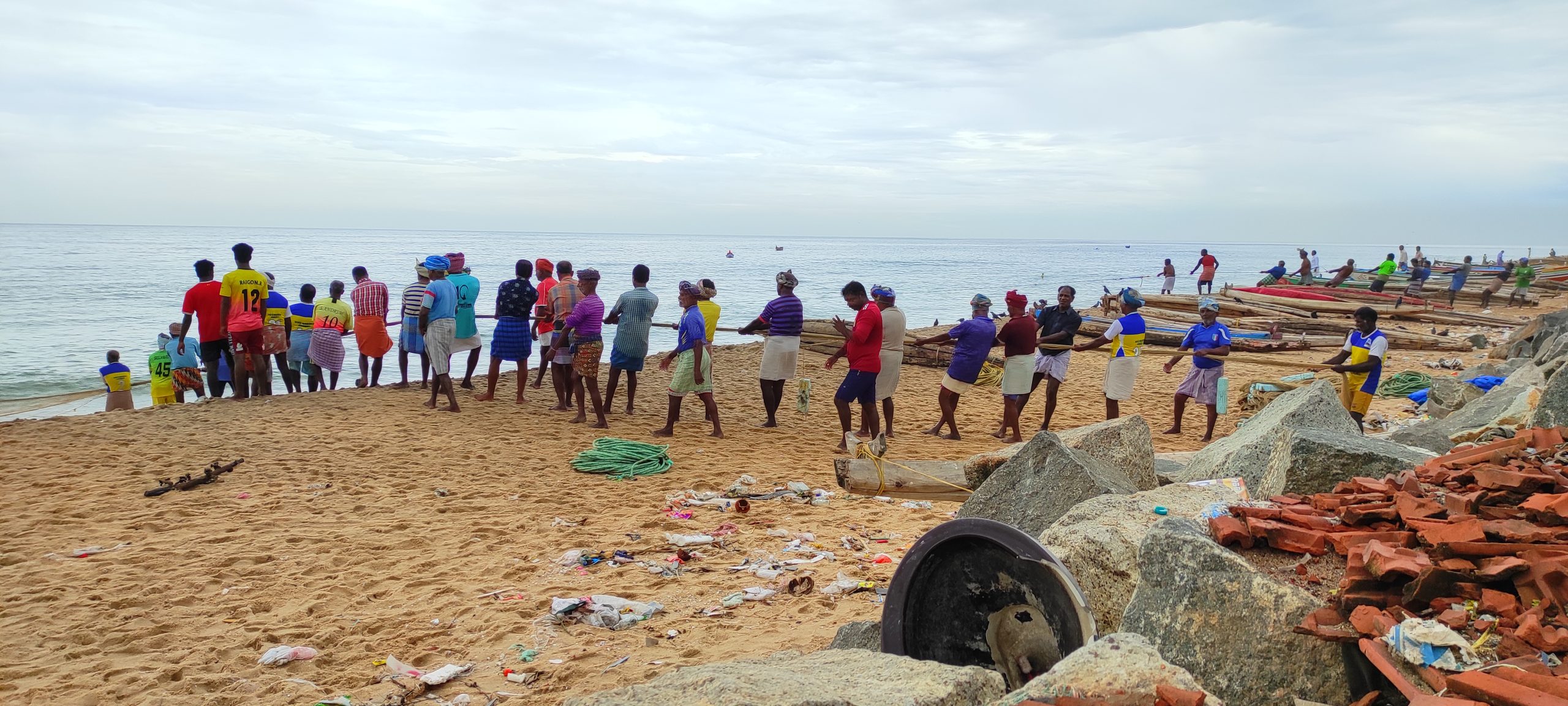
Climate change is threatening livelihoods and traditional ways of life for India’s marine fisherfolk, but community organisation is spearheading resistance and adaptation. Policy frameworks must shift towards structural reform to translate these successes into broader resilience.
For generations, India’s fisherfolk have lived inseparably from the sea, drawing not only their livelihoods but also their identities, languages and festivals from the marine environment along the country’s 7,500km coastline. These coastal communities are far more than economic actors – they are the custodians of rich maritime traditions, with distinct languages and cultural practices. The term ‘kadalamma’ – Mother Sea in Malayalam – captures the depth of this bond between the sea and fisherfolk.
However, in recent years, the coast has become a place of disruption and displacement due to climate change, poorly planned infrastructure development and environmental degradation. The crisis is more than just environmental, as uncontrolled coastal development destroys mangroves and fishing infrastructure, saltwater intrusion makes farmland barren and rising waters destroy houses. For the 4.9 million marine fisherfolk who are the backbone of India’s fishing industry, these forces are tearing down their traditional ways of making a living and the cultural foundations that hold their communities together.
As the sea advances, many fishing families are forced to move into unfamiliar urban spaces, where they often find themselves seeking livelihoods in precarious markets without legal protection, transferable skills or vital social support networks. For many, especially women, this upheaval has brought immense challenges – but it has also sparked new forms of collective action and adaptation. Amid the loss, these communities continue to draw on their deep knowledge of the sea and their heritage, finding ways to cope and support each other.
The rising tide of displacement and loss
In the years leading up to 2025, India witnessed a series of natural disasters, especially a barrage of cyclonic activity, with around 27 cyclones forming between 2019 and 2023 alone, of which four were classified as severe. This resulted in significant damage to infrastructure and many people were displaced and forced to relocate. Fisherfolk were the majority of those affected: recent cyclones have flattened entire fishing villages on the country’s eastern coast, sinking or splintering thousands of boats and destroying landing sites. The losses experienced were not just the result of headline-grabbing disasters. They reflect the slower, cumulative effects of sea-level rise, recurring storms, saltwater intrusion and uncontrolled development projects and policies.
The National Centre for Coastal Research reported in 2018 that about one third of India’s coastline shows measurable erosion. The most severely hit stretches include West Bengal, where nearly two-thirds of the shoreline has retreated; Pondicherry, with more than half lost; Kerala, with almost half eroding; and Tamil Nadu, where close to 41% of the coast is affected.[1] Meanwhile, amendments to India’s Coastal Regulation Zone (CRZ) rules lifting bans on land reclamation for commercial purposes and projects like the Vizhinjam International Seaport in Kerala intensify coastal erosion and displace fishing families.
The Central Marine Fisheries Research Institute (CMFRI) reported that in eastern coastal states such as Odisha and West Bengal, fish populations face a ‘triple burden’ of rising sea temperatures, ecological stress from heavy fishing and naturally lower productivity linked to the region’ shallow shelf, high sediment load and seasonal salinity changes in these waters.[2] Fishers recall that catfish, butterfish and ribbonfish once filled their nets near to the shore. Many of these species have migrated into new waters or disappeared altogether. For coastal residents, ecological decline intersects with legal and political vulnerability. Most traditional fishing communities lack formal land titles; this makes them more exposed to forced relocation when flooding or land-loss events occur.
Together, these trends map a pattern of ecological uncertainty that fishing communities are struggling to survive. For such communities, the impact is not confined to economic loss; it also unsettles cultural and social life. Fishing practices that once bound generations together now have no secure future, leaving traditions in danger of vanishing.
From sea to urban periphery
The loss of traditional fishing is not only a matter of declining incomes; it forces communities to make difficult choices related to issues of dignity, survival and identity. In practical terms, many displaced fishers end up as daily-wage workers in expanding port towns, or as seasonal migrants to distant places. Existing research on unskilled labour migrants’ conditions suggests that the work is insecure and often precarious. Without written contracts, they are left open to wage theft, harassment or debt that ties them to exploitative arrangements. Men who travel long distances from their villages to work as deckhands or in onshore seafood processing facilities sometimes describe the journeys as life-threatening, involving unsafe vessels, poor working conditions and, in the case of those who stray toward neighbouring waters, the constant risk of detention by foreign coast guards.
The disruption weighs differently on women. Traditionally, they have sustained coastal economies through fish vending, mending nets or processing catch for local sale. With the shrinking of beach space and the rapid commercialisation of waterfronts, it is more challenging to sustain these traditional post-harvesting livelihood options. Many women, particularly from villages facing displacement, are pushed into low-paid urban domestic service or sanitation work. While providing a small income, these jobs offer little recognition and no social security and expose them to frequent discrimination. Widows and single women, who often shoulder the responsibility of both income generation and caregiving, are especially vulnerable.
The changes are not limited to one generation. Young people, recognising the uncertainty of fishing livelihoods, increasingly move inland or to nearby towns in search of factory, driving, delivery or retail jobs. Yet these opportunities often confine them to the bottom rungs in fragile urban labour markets, providing neither long-term stability nor career progression. For many older people, the loss is deeply personal. Fishing knowledge and skills, once central to life and learned by heart, are no longer practised, and with every generation that leaves, traditions and identity are eroded along with the coast itself.
Women’s collective action
To meet these challenges, fishing communities have drawn on deep traditions of solidarity and mutual support. Women, in particular, have become central to this process, stepping into organising, advocacy and market innovation roles.
Cooperatives that once focused simply on providing credit or sharing equipment now demand rights, push for fairer prices for their catch and bargain directly with state authorities. Alongside these cooperatives, women’s Self-Help Groups (SHGs) have taken on a new life, transforming economic and social relationships within coastal villages.
One widely noted example is the Samudram Federation in Odisha. It began modestly, with women coming together against domestic violence and alcoholism. Over time, it has grown into a federation spanning 46 villages, with more than 4,000 members. By pooling small savings and working collectively, women bypass middlemen and purchase fish in bulk for direct sale. This change improves prices and gives them far greater bargaining power. As one member, A. Aramma, put it: “Twelve of us together can buy and sell in amounts that would have been impossible for any of us alone.”[3] Building on this legacy, recent government-supported initiatives have organised into structured networks over 260,000 women from 1,199 SHGs managing more than 520 hectares of panchayat (village-council)-owned ponds for sustainable fish farming.
Similar momentum is seen in Kerala, where women fish vendors have taken collective action to secure formal recognition. In 2024, the first India Fisherwomen Assembly convened in Kerala, spotlighting their leadership in demanding market access, resisting displacement and claiming space in fisheries decision-making. Studies have documented how fisherwomen’s cooperatives and movements are helping reduce exploitation while expanding social protections in South Kerala’s fish vending sector.
Community resistance
Across coastal regions of India, where government support often falls short, fishing communities have organised sustained resistance to defend their homeland, waters and livelihood. In Honnavar, Karnataka, fisher families have protested against the proposed Honnavar Port Private Limited (HPPL) project since 2012. What began as opposition to inadequate consultation has evolved into over a decade of resistance against a port threatening to displace five fishing villages affecting over 23,500 fisherfolk.[4] The protests intensified dramatically in February 2025. On 24th February, thousands gathered at Kasarkod beach, with over 50 demonstrators wading into the sea, threatening mass suicide if the project proceeded. Police detained more than 100 protesters. Similar struggles are unfolding elsewhere along Karnataka’s coast. At Keni village in Ankola, Uttara Kannada district, residents have resisted JSW Infrastructure’s proposed INR 41.19 billion port since learning of it in late 2024. In February 2025, hundreds of fishermen protested the geotechnical survey, with some jumping into the sea in desperation. Despite prohibitory orders, the community continued demonstrations, fearing the port would destroy fishing grounds that sustain 2,882 people.[5]
Kerala’s fisherfolk have mounted one of the most sustained protests against the Adani Vizhinjam Port project. What began in 2015 with construction has triggered years of resistance from fishing communities who report accelerated coastal erosion and loss of homes. The protests reached a peak in August 2022, with fisherfolk maintaining a 100-day blockade of the construction site. Violence erupted in November 2022 when protesters stormed a police station after arrests, resulting in injuries to 36 officers and damage to police vehicles. Over 3,000 people were charged in connection with these events.[6] The environmental impacts driving these protests are documented and severe. In Vizhinjam, construction of breakwaters and extensive dredging have altered sea currents, causing erosion that has displaced over 600 people from villages like Valiyathura and Muttathara into temporary government shelters, rendering them effectively internally displaced. The Times of India reports that, as of June 2025, the government has distributed INR1.15 billion in compensation to 2,940 affected families, though many argue this is inadequate.[7] Yet these acts of resistance take place within a hostile policy landscape. Most fisherfolk lack formal recognition as displaced persons or as rightful owners of ancestral lands and waters. This invisibility restricts access to compensation, resettlement assistance or social security programmes.
As noted above, legal frameworks like India’s Coastal Regulation Zone (CRZ) Notification, designed to protect fragile shorelines, are frequently weakened by loopholes or poor enforcement. Fisher communities are rarely consulted when adaptation or relocation schemes are developed, leading to solutions that risk further marginalisation. Despite these barriers, fisher unions, community groups, religious leaders and legal advocates continue pressing for meaningful coastal rights. They demand compensation for lost commons, dedicated funds for environmental remediation and genuine inclusion in disaster planning efforts. Yet progress remains slow, stalled by bureaucratic inertia and failure to acknowledge customary tenure systems.
Recommendations
India’s marine fisherfolk face interlinked threats but, as experience across India’s coastline shows, vulnerability is not destiny. Where communities have organised – through Self-Help Groups in Odisha, fisherwomen’s assemblies in Kerala, or decade-long protests in Karnataka – they have reclaimed market power, stalled destructive projects and negotiated better terms for their livelihoods.
Policy frameworks must shift from episodic relief toward structural reform to translate these successes into broader resilience. First, India needs dedicated coastal-rights legislation that formally recognises customary tenure rights and guarantees rehabilitation after climate shocks. Strengthening enforcement of the Coastal Regulation Zone rules and mandating genuine community consultation before approving ports, land reclamation or other coastal infrastructure will help safeguard fishing habitats and fishers.
Second, social protection must be universalised for all fish workers, including women in post-harvest roles. Portable benefits, such as insurance or pension contributions that move with migrant workers, will ensure continuity of protection when fishers travel for work. The transnational dimensions of fishing also require urgent attention. When fishers cross maritime boundaries seeking resources, current frameworks treat them as security threats rather than people adapting to environmental stress. Regional cooperation on fishing regulations, navigation safety and labour protections could transform these movements from criminalised border crossings into recognised adaptation strategies.
Finally, climate adaptation for fisherfolk is inseparable from ecosystem restoration and commons protection. Recognising and compensating traditional knowledge holders in these restoration efforts validates local expertise and embeds long-term stewardship. By centering fisherfolk’s agency, embedding resilience into law and aligning regional cooperation with local realities, India can transform its coastal challenges into a model of inclusive, rights-based adaptation – one that honours the bond of kadalamma, Mother Sea, and secures both livelihoods and cultural heritage for generations to come.
Jyothi Basu Rajayyan
Doctoral Research Fellow
Centre For Human Rights, University of Hyderabad, India
jyothibasur5@gmail.com
[1] Kankara R A, Ramana Murthy M V and Rajeevan M(2018) National Assessment of Shoreline Changes along Indian Coast: A Status Report for 1990–2016, National Centre for Coastal Research (NCCR), Ministry of Earth Sciences, Government of India
[2] ICSF (2021) ‘India: As climate changes, our fish are at sea’
[3] Mongabay (2020) ‘Ganjam fisherwomen unite to get back fish trade from monopolistic traders’
[4] Contested Ports ‘Honnavar, India – Contested Ports’
[5] Land Conflict Watch ‘Keni villagers protest port project over land and livelihood concerns’
[6] ‘Adani Port: Violent protests over billionaire’s Kerala project’, BBC News, 28th November 2022
[7] ‘Compensation to families affected by Vizhinjam port work’, Times of India, 30th June 2025
READ THE FULL ISSUE