
- June 2026
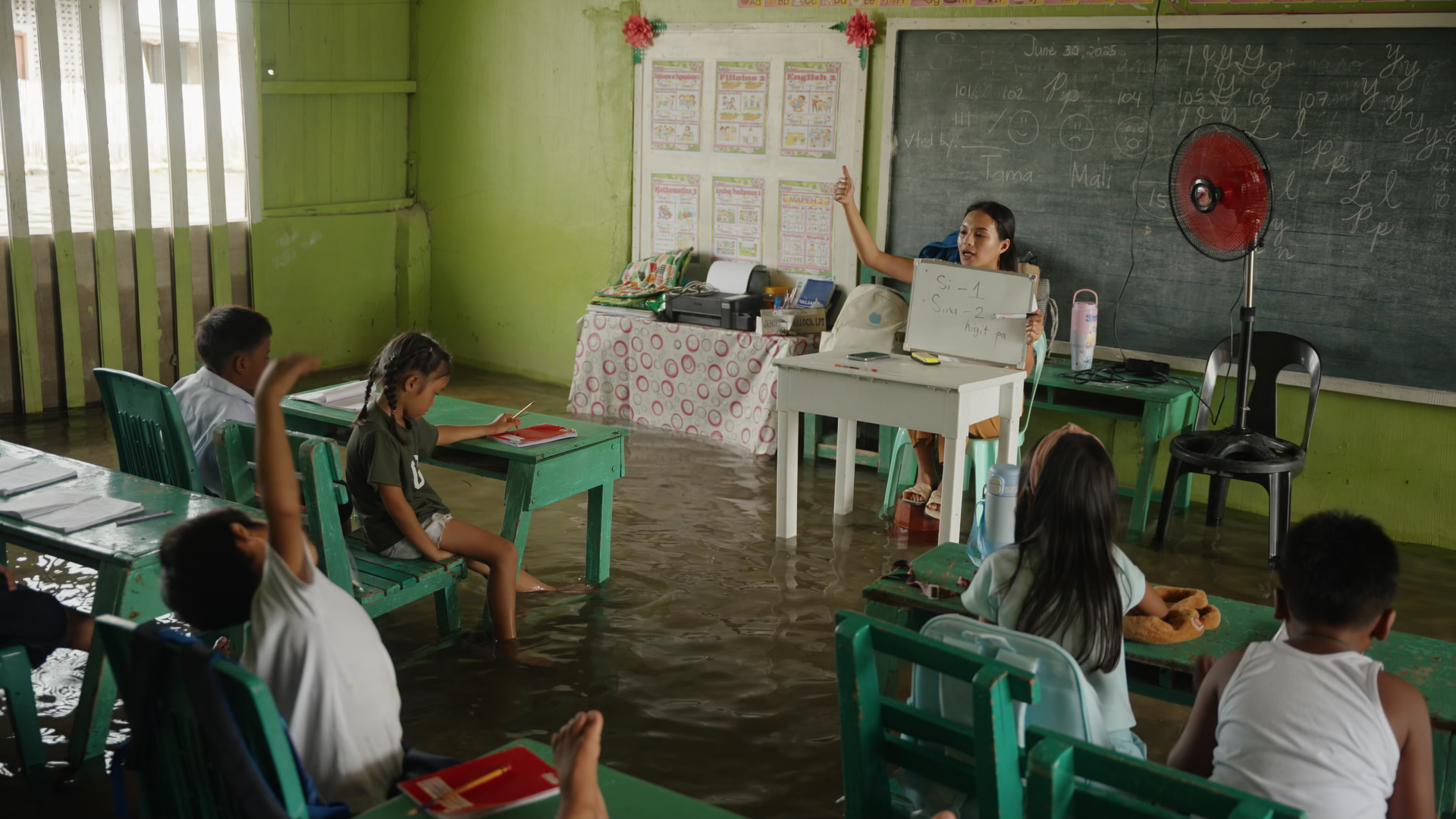
The choices made by island and coastal communities threatened by climate-related disasters represent forms of constrained agency – weighing up options within the bounds of what is possible, they invest in education and livelihoods, reinforce housing and migrate as a proactive strategy.
Climate-related disasters displace millions of people each year. In Asia Pacific, 95% of the 225 million people internally displaced between 2010 and 2021 were displaced due to climate-related hazards.[1] According to the IPCC Sixth Assessment Report, relative sea level rise (SLR) in the region is already twice as high as the global average; intense heat waves and ever more extreme storm events are at record highs. Displacement is recurrent as risks to climate-vulnerable communities remain and heighten. However, displaced communities frequently choose to return, rebuild and stay rather than move permanently.
This article is based on an analysis by the Research and Advocacy for Climate Policy and Action project (RACPA) of the climate-related risks faced by the island and coastal communities of Tambakrejo and Wonoagung in the Semarang and Demak districts of Central Java, Indonesia, and the island of Nocnocan in Bohol, Philippines. [2]
Water from the sky and sea
The dual slow-onset phenomena of rising sea level and land subsidence have severely impacted the Bohol islands and coastal communities of Central Java. In 1993, Tambakrejo coastal village experienced tidal waters that reached its settlements. By 2000, the village cemetery and other public facilities had been submerged. Tidal floods in the community have since become a regular recurrence. To the east of Semarang, Demak’s coastline is eroding at 279.1 metres per year.[3] The Semarang coastline is sinking at an annual rate of 10-12cm and its annual rate of sea level rise is more than 4.2mm, compared to the global mean rate of 3.05mm per year. In the Philippines, satellite imaging of Nocnocan Island reveals a 260-square metre average annual shrinkage between 2014 and 2023 and about two thirds of the island will be below annual flood levels by 2050. Slow-onset disasters are not slow at all.
From January to June 2025, there were 162 disaster incidents in Central Java, including the flooding of 730 hectares of agricultural land and closure of the northern coastal road due to frequent and prolonged tidal flooding. On Nocnocan Island, sea level rise has impacted drinking water supply, while the opportunity for rainwater collection has been reduced to three or four months a year. The price of one litre of water is 300% higher than on the mainland when it reaches the island and as a result, 20% of household spending on food and drink goes to bottled water.
In Indonesia, disaster assistance is provided only during floods from rains (banjir) but not during tidal rises (rob) due to a loophole in the national disaster management policy framework. The policy discourse has changed recently to include tidal flooding as a disaster event even as the legal definition of disaster remains exclusive to floods from rains.
To move or stay: beyond economic risks
The decision to move or stay is rarely based solely on exposure to hazards. It is intertwined with lived history, livelihood realities and deeply held attachments to place and people which persist even as climate change magnifies vulnerability. These communities show that climate displacement is neither passive nor inevitable; they are constantly weighing options within the boundaries of what is possible.[4]
The community’s appreciation of risk goes beyond economic loss and damage; non-economic values factor in their choices in the form of cultural identity. In one case, a couple whose 40-year investment in fishing was swept away during a 2021 typhoon still opted to rebuild rather than move, even though they had some savings to cover part of the relocation costs. As fishing goes back many generations, shifting identity from fishing to farming among island communities (or the reverse in the Indonesian case), is perceived as a serious cultural and personal identity loss.
Climate change has thus posed a new threat to human security in the form of the loss of cultural values and knowledge that are central to the community and individual. The quality of life in these archipelagic areas cannot be sustained in the long term without addressing these risks and vulnerabilities.
Expressions of agency
Making the decision to move is not the default option chosen by many living in at-risk locations. In Wonoagung and Tambakrejo, permanent relocation is typically considered a last resort. People who choose to move frequently stay within the same locality so as to retain access to the farmlands or sea that underpin their identity and economy. Sometimes people move strategically: the experience of devastation from Typhoon Rai, which damaged over two thirds of the houses on the island, taught some women in Nocnocan to heed early warning signals and temporarily evacuate in anticipation of a typhoon
However, adaptation in place is the most common expression of agency. In Nocnocan, two years after Typhoon Rai, many families had reinforced roofs, walls and foundations – mostly without significant external support. In coastal Central Java, most of the residents raise their houses every five years due to tidal flooding and land erosion. In one case, a family had to elevate their house three times, with each renovation costing about USD 300-600; for comparison, the monthly minimum wage in the region was around USD 125 in 2025. They had to forego surgery for their child, who had a disability. Some households have shifted from rice farming to aquaculture or wage work, and in some cases they combine these with environmental improvement measures such as planting mangroves. These actions reflect an active choice to remain and adapt in situ, not simply an absence of mobility.
Investing in future generations is another form of agency. Across all three sites, households place a high value on education despite limited incomes, because they believe it will help young people find stable employment outside their risky home environment. In Nocnocan, education was the second-largest household expense after post-disaster housing repairs, and a majority would advise young people to move elsewhere, according to a survey carried out as part of the RACPA research.
Structural and cultural constraints
While island and coastal residents show agency in reinforcing houses, adapting livelihoods and investing in education, their actions unfold within tight boundaries set by structural and cultural limitations.
Economic limitations are among the most decisive. In all three sites, livelihoods are rooted in place-specific resources. In Nocnocan, over half of households depend on fishing, and 86% of male-headed households rely on it exclusively. Wonoagung’s shift from rice farming to aquaculture was a necessary adaptation to tidal flooding and saltwater intrusion, but this required capital and skills that not all households possessed, thus widening economic gaps. Place-bound livelihoods, combined with low and frequently unstable incomes, limit relocation options since comparable opportunities that fit their skillset may not exist elsewhere. Additionally, debts from post-disaster rebuilding or livelihood investments further restrict financial flexibility. Migration is more feasible when income is portable, which is uncommon among those whose livelihoods depend on environmental conditions and resources.
Cultural and social bonds also anchor people even when risks are recognised. Family ties were the most cited reason for staying according to the RACPA survey: 67% in Nocnocan, 73% in Wonoagung, and 41% in Tambakrejo remain as a result of kinship connections. Multi-generational households and strong caregiving expectations reinforce this rootedness. For many, the village or island is more than a home – it is a repository of identity, history and belonging. In Tambakrejo and Nocnocan, men’s sense of place is intertwined with fishing as livelihood and heritage. Long-term residence patterns in all three areas, with families often settled for two generations, deepen attachment despite environmental degradation.
Gendered inequalities shape mobility decisions. Women are twice as likely as men to consider migration, but face gender-related barriers linked to their more limited financial means, their caregiving responsibilities and to the more limited professional opportunities available to them due to gender stereotyping. Women-headed households often diversify income through small businesses or by using their pensions as capital, making livelihoods more flexible, but five times more women than men in Nocnocan cited family presence as a reason for staying. Women’s aspirations for children’s education and safety frequently collide with concerns over the suitability of relocation options.
Policy gaps compound these limits. In the Philippines, national and local climate change actions tend to prioritise post-disaster recovery and evacuation above proactive resettlement even though policies and plans recognise both as important. Barriers include limited safe land for resettlement, complicated acquisition procedures and lack of acceptance by communities facing relocation. In Indonesia, although regional adaptation plans exist, there is no national law to frame climate change adaptation and relocation for people affected by tidal flooding. Furthermore, local implementation is hindered by limited budgets, weak intergovernmental coordination and lack of technical capacity. Without well-funded, forward-looking frameworks, communities are left to navigate their own constrained options.
Finally, it should be noted that the nature of governance is pivotal in climate change and disaster management as well as in ensuring social protection for vulnerable populations. Reducing governance constraints through inclusive policy frameworks, informed and participatory decision-making, and investing adequate resources for social protection, results in increased agency for climate vulnerable communities.
For many, the ‘choice’ to stay is therefore a form of constrained agency: an expression of adaptation within the limits of available resources, supportive governance and acceptable cultural change. For others, aspirations to move remain unrealised because the means, mechanisms and secure destinations are absent. This is the predicament of populations who may be willing to move but are effectively trapped.
Enabling an informed choice
Choice is at the core of agency, where people are free and able to choose what they want to be and what they want to do. Enabling an informed choice is therefore an imperative task for all stakeholders in addressing climate risk and averting displacement.
Science and socio-cultural dialogue
While the predictive value of science is important, it must coexist with social and cultural realities as bodies of knowledge which can enable informed choices. RACPA promotes dialogue between socio-cultural and scientific processes through participatory community mapping and a learning exchange model.[5] With satellite imaging and community mapping of their biophysical landscape, as well as multistakeholder field visits to external communities experiencing similar climate challenges and contexts, island and coastal communities are able to ‘own’ their experience of current and future climate risks and realities. Climate risk is deeply uneven and gives rise to layered vulnerabilities that are not always captured in conventional risk assessments. Therefore, understanding climate risks must begin not just with predictive models, but with open conversations and listening deeply to people’s lived experiences of change, loss and adaptation.
The risk vs choice equation
A crucial question is why vulnerable communities choose to stay. Logically, the higher the risk, the higher the likelihood of leaving should be. However, this is not what often happens. There is no simple answer to this risk vis-à-vis choice equation and more study is needed regarding risk perception, different attitudes towards mobility, and what shapes certain choices as opposed to others. RACPA’s research offers the following lessons:
- There is a significant positive change in a population’s willingness to move if support – both financial, and in the form of access to basic services and safety in the relocation site – is secured.
- People are more willing to face uncertainties in a place to which they are accustomed than in a place they do not know, for example, a relocation site. They define what is habitable and what risks they can live with.
- While moving is a household decision where family unity is valued, age and gender play a role in the decision-making. Men are more likely to have the final say, while the older generation often advise younger generations to move and invest in education and other opportunities outside their community.
- Attachment to place and livelihoods is the strongest reason people stay and it is important to acknowledge these non-economic risks. Even livelihoods have nuanced, non-economic dimensions that are attached to specific cultural identities and places.
- Enabling informed choices requires ensuring that mobility is framed as a matter of dignity and rights. The Global Compact for Migration commits to reducing the adverse drivers and structural factors of forced displacement and enabling policies for people to stay in safety. In practice, the Australia-Tuvalu treaty, though imperfect and facing implementation challenges, shows how states can translate the principle of mobility with dignity and safety into concrete commitments. Such frameworks expand agency by ensuring that relocation, when it occurs, is anchored in the principles of rights, safety and respect for cultural identity.
- Facilitating dialogue among stakeholders to try to bridge the gap between perceptions of risk and the desire for choice would lead to more informed community decisions and better public policy. The frameworks used in analysing and valuing climate risks must address what vulnerable communities hold dearest as the choice is ultimately theirs to make.
Louie Bacomo
Director, Climate and Forced Displacement, Jesuit Refugee Service Asia Pacific
louie.bacomo@jrs.net
Haryani Saptaningtyas
Lecturer, Postgraduate School, Sebelas Maret University
h.saptaningtyas@staff.uns.ac.id
Rowena Soriaga
Director for Programs, Environmental Science for Social Change
rowenasoriaga@essc.org.ph
The authors would like to thank RACPA staff, partners, and communities in Thailand, Indonesia and the Philippines.
[1] ‘Disasters triggered 225 million internal displacements across Asia and Pacific region between 2010 – 2021’, Internal Displacement Monitoring Centre, 19th September 2022
[2] Jesuit Refugee Service Asia Pacific ‘Climate Action: Research and Advocacy for Climate Policy and Action’
[3] Dian N Handiani, Aida Heriati and Fitry Suciaty (2022) “Coastal Vulnerability Assessment Along the North Java Coastlines-Indonesia,” Jurnal Segara, Vol 18 (1): 1-12
[4] Jesuit Refugee Service Asia Pacific (2024) Climate Change, Human (Im)mobilities, and Resilience
[5] Lee, Jenny Lynn and Sylvia Miclat (2025) ‘Government attention, a repeated request in climate resilience planning’
READ THE FULL ISSUE