
- September 2026
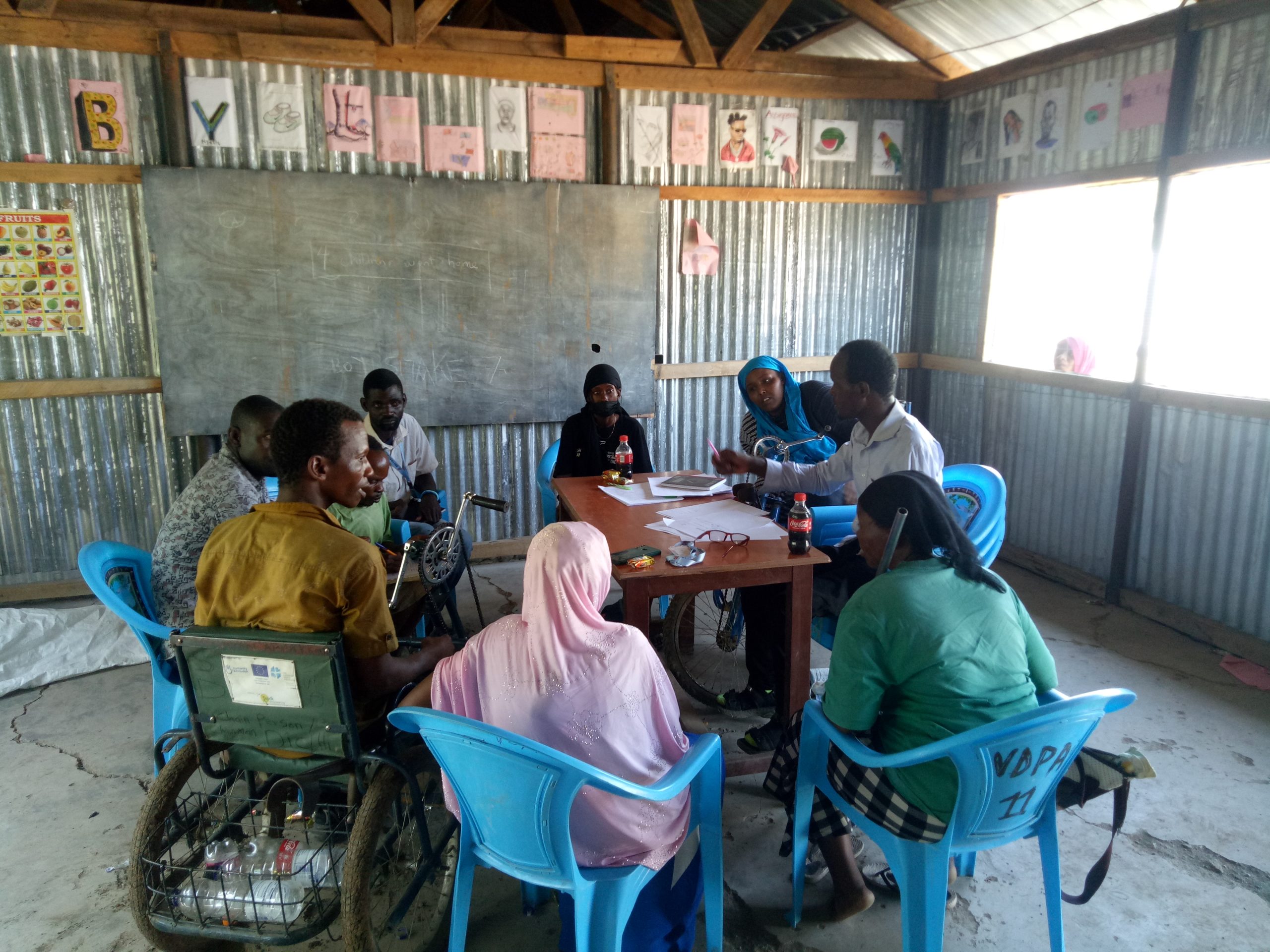
Drought has a particular impact on the livelihoods of young people with disabilities in Kenya’s Kakuma Refugee Camp. They are finding ways to adapt, but better access to education, tailored training around drought and a greater say in the programmes designed to help them are needed.
In Turkana County, home to Kakuma Refugee Camp, droughts are becoming more frequent, intense, and prolonged.[1] Drought intersects with Kenya’s refugee policy, age and physical disability to make the livelihoods of refugee youths with physical disabilities (RYWPD) particularly vulnerable. This article explores how RYWPD in Kakuma adapt their livelihoods to the impact of drought.
Livelihood activities
Data were collected through focus group discussions and in-depth interviews. All participants were receiving humanitarian aid in the form of food assistance and/or Bamba Chakula (a World Food Programme cash transfer) but found this was inadequate to achieve a basic standard of living, prompting them to pursue other livelihood activities. These included operating small businesses, such as running retail establishments or selling charcoal, and providing services, including tailoring and bead-making. A few participants engaged in subsistence-level kitchen garden farming and selling surplus produce. One participant primarily relied on begging.
The impact of refugee policy
Kenya’s Refugee Act restricts refugees to livelihoods that are not based on natural resources, primarily in businesses and kitchen gardens within the camp. The arduous process of acquiring a work permit or business permit outside the camp severely limits external income-generating activities. This often results in unfavourable employment terms, as the range of jobs available in the camp is limited. It can also result in unfavourable purchasing terms because RYWPD have to rely on third parties to buy or sell goods outside the camp, a process which can be unreliable. For example, one participant said she waited for a long time to get stock from Nairobi for her business in Kakuma since her contact person had other engagements, leading to lost sales. Another participant said, “We study but we are not allowed to work outside (the camp), jobs here are limited and not everyone can be employed”.
Doing business in the camp is expensive, especially during droughts. Participants have few suppliers to choose from, which limits their negotiating power. In addition, wholesale prices are high due to high transportation costs and the scarcity of products, especially agricultural goods. Coupled with low financial capital in participant-owned small businesses, this makes it difficult to maintain and scale up businesses while keeping retail prices at affordable levels. The result is low customer turnout and profits, as one participant explained: “During the recent (2022-2023) drought, I had one or two or no customers in a day. I almost gave up on my business”.
The impact of disability and age
Physical disability intensifies the impact of pre-existing livelihood barriers in that it constrains mobility and the physical ability to pursue manual work, and because of social perceptions of inability or social rejection. For instance, one male participant would like to look for water to sell when there are droughts because it is usually a lucrative business but cannot ride a bicycle or a motorbike to do so. The camp’s disability-insensitive physical infrastructure also hinders access to goods and services necessary for adapting livelihoods. A participant said, “Organisations don’t want us because they don’t have good buildings where we can get in with ease, even those that are supposed to speak for us”.
Discrimination also pervades all aspects of participants’ lives: at places of work, by organisations, at hospitals, at food distribution points and at water points. This prejudiced treatment, as well as self-disqualification, limits the pursuit of adaptive strategies. One male participant said, “I am forced to queue like others without disability. We must give way to those without disability. There is no one to help me fetch water, and I have to get water competing like those without disability”.
Physical limitations and the absence of piped water infrastructure exacerbate water stress among RYWPD. Water points and seasonal rivers dry up, requiring long-distance travel or alternative means of accessing water, such as digging shallow wells along the riverbed. However, RYWPD lack the physical energy to dig wells, travel long distances, or compete vigorously for access to water at the few rationed water points. One female participant explained that it takes her more than six hours to fetch water from the laga (a temporary river), which is far away, and she is only able to walk slowly. RYWPD often lack the financial resources to buy water and tend not to have children, who are typically tasked with fetching water in the camps; they thus lack ways of compensating for their disability, exacerbating the impact of water scarcity on their livelihoods.
Crop failures and increased food prices, both within and outside the camp, exacerbate food scarcity during droughts. Disability limits the ability of RYWPD to adapt, restricting their ability to manoeuvre across rough terrain to collect wild vegetables, while their difficulties with accessing water restricts the use of kitchen gardens. Although food rations may guarantee food security in theory, RYWPD are constrained by the physical energy required for vigorous competition at food distribution points.
RYWPD are particularly susceptible to health impacts associated with the camp environment, such as nutritional deficiencies, consuming contaminated water and exposure to dust. Health tends to deteriorate particularly during drought seasons, especially among those with thermal dysfunctions, such as cerebral palsy. This inhibits the ability of RYWPD to engage in income-generating activities.
Age is another compounding factor. Youths have limited capital assets, which in turn limits them to small-scale livelihood activities that are especially vulnerable to the effects of drought. One female participant noted that “most of the time I use the knowledge and experience (in tailoring) from the older persons so I have to stay with the older business people to get advice and other knowledge not taught in training”.
To overcome these intersecting impacts of drought, disability and age, RYWPD have to sacrifice resources, including money and time, which could be used to make livelihoods productive and profitable.
Adaptive capacities and their limits
Financial capacities
People with disabilities are often the poorest in any community and lack the financial capacity to modify their livelihoods in response to droughts. Refugees are excluded from digital banking systems like M-Pesa: participants explained they needed a Kenyan citizen to open an M-Pesa account. The camp’s financial infrastructure is characterised by informal systems, such as village savings and loan associations (VSLA), self-help groups, saving by stockpiling goods and borrowing from family members. Organisations working with RYWPD were also frequently mentioned as providing financial assistance. One participant who joined a VSLA said that he would take a loan during droughts as an alternative to closing his shop and risking the failure of his business.
Limited financial capacity can restrict the effectiveness of livelihood adaptation strategies. For example, participants explained that they used wet blankets to keep stock cool because they could not afford a refrigerator, which would be a more effective solution. One participant explained that they borrowed small amounts to keep their business going: “I borrow from family, neighbours and friends and pay [them back] in instalments. I borrow when my business is bad and I pay little by little”. Thus financial limitations enable short-term, ad hoc fixes rather than actual adjustments to small businesses that might make them more resilient going forward.
Social capacities
RYWPD use their social networks to modify strategies for adapting livelihoods to drought. Participants’ social networks were based on family, friends, community, local organisations and other people with disabilities. These networks provide support in areas where capacities to adapt to drought are deficient. Most participants noted working with family members to operate businesses and assist in physically demanding tasks such as fetching water. For instance, one participant employed a non-disabled friend in his barber shop for shaving and for physically demanding tasks such as fetching water, especially during droughts. RYWPD also leverage social networks to access information about livelihood opportunities and support. For example, one male participant said, “My friend told me about Inkomoko [an organisation that supports entrepreneurship for forcibly displaced people], I searched them online and found out that they provide training in Kakuma town.” Another participant said that Voice for Disabled People Association, a refugee-led organisation that supports people with disabilities in Kakuma, links RYWPD with each other and with clients to expand their business networks.
Human capacities
Education facilities rarely meet the needs of RYWPD, which prevents them from acquiring the skills and scientific knowledge necessary to adapt. As a result, the majority of RYWPD participants develop and improve capabilities through experience and through training and skill development programmes provided within their area of residence by refugee-led organisations and NGOs such as the Jesuit Refugee Services. These programmes include psychosocial support through non-technical courses, such as counselling, to help instil self-worth and confidence, which helps RYWPD make use of their knowledge and skills to adapt their livelihoods to drought.
Not everyone has access to these programmes, as organisations helping RYWPD struggle to secure adequate funding for programmes that address their needs. For instance, one participant said, “The other reason my business does not adapt is ignorance from my side because I’m an illiterate person”. NGOs can help fill the gap, however. Another participant said, “Danish Refugee Council helped me from being a casual employee to owning my business where I have employed other people”.
Adaptation and resilience
Despite the barriers they face, RYWPDs do modify livelihood strategies to adapt to droughts. They diversify within one livelihood strategy and among many strategies to spread the risk of failure. For instance, one participant with three livelihood strategies explained, “The Danish Refugee Council has helped me to rear livestock [poultry] and to add other sources [of income] in addition to business so that when business is low, poultry helps in raising money for my children”. Another participant explained that he sold a variety of products in his shop, as some sold quickly during droughts. For example, the participant added cold soft drinks to his inventory. This diversification allowed some livelihoods to remain productive and profitable during droughts, despite the failure of others.
RYWPD restock their businesses with small quantities to avoid products deteriorating due to factors such as extremely high temperatures and low customer turnout. Restocking in small quantities, especially agricultural products, ensures that the stock is sold before it spoils. For instance, one participant said, “These effects of drought, when you buy commodities in bulk like tomatoes, most of them get bad but when you buy them as few [ie in small quantities], customers come for them in time”.
Selling on credit or purchasing through debt helps small businesses to remain productive and profitable. During droughts, customer turnout is low, and there is less money in circulation in the camp. RYWPD sell on credit to retain existing customers and attract new ones. Credit sales or purchases are guaranteed by Bamba Chakula: one participant said, “I also sell on credit a lot this time and people pay when they receive Bamba Chakula. However other people fail to pay, which affects my business”. Some participants said they had had to close previous businesses due to bad debt.
Although there are trade barriers, the majority of RYWPD participants use social networks within the camp and on social media to sell products outside the camp, overcoming the issue of low customer turnout. Two participants who practise beadwork and weave bedsheets said that they had external clients who bought from them during droughts. One participant said that their organisation links RYWPD with external clients.
As noted, refugees are restricted from exploiting natural resources, such as forest products, and can only purchase these from the host community. Despite these restrictions, RYWPD engage in environmental management, including planting trees to mitigate the impact of dust and excessive heat on livelihoods. One participant explained, “There was a lot of sun in 2010, there was dust but now God has helped us, there are a lot of trees, no dust, and you can feel the shade”. The capacity of natural resources to mitigate the effects of drought enables the operationalisation of livelihoods which would otherwise have been impossible.
Recommendations
- NGOs should help to improve the physical infrastructure of educational institutions, especially secondary schools, to make them more accessible and increase academic enrolment for RYWPD. An enabling academic environment would provide the necessary scientific knowledge, skills and information to enable RWYPD to adapt their livelihoods in times of drought.
- RYWPD require training and capacity building specifically on the impacts of, and mitigation and adaptation to, drought. This would enable them to develop resilient, transformative adaptation strategies at the individual and community levels. NGOs should integrate building drought-adaptive capacity into their programmes. This includes, among other things, providing early warning information, training on water management, heat management strategies, and training on livelihood adaptation such as livelihood diversification and resource optimisation.
- Participants claimed that they are rarely consulted on programmes designed to address their challenges. Organisations need to consider placing those with disabilities at the centre of their programme lifecycle to influence decisions and outcomes.
Peter Muraya
Research Affiliate, Refugee-Led Research Hub, Nairobi, Kenya
murayapeter129@gmail.com
X: @murayanjerii
The research was funded by the Kenya Evidence Platform (KEP), an initiative of the Regional Durable Solutions Secretariat, in partnership with the Refugee-Led Research Hub and Maseno University. KEP is a three-year project funded by the Kingdom of the Netherlands through the Ministry of Foreign Affairs.
[1] Linke AM, Witmer FDW and O’Loughlin J (2020) ‘Do people accurately report droughts? Comparison of instrument-measured and national survey data in Kenya’, Climatic Change 162: 1143–1160
READ THE FULL ISSUE