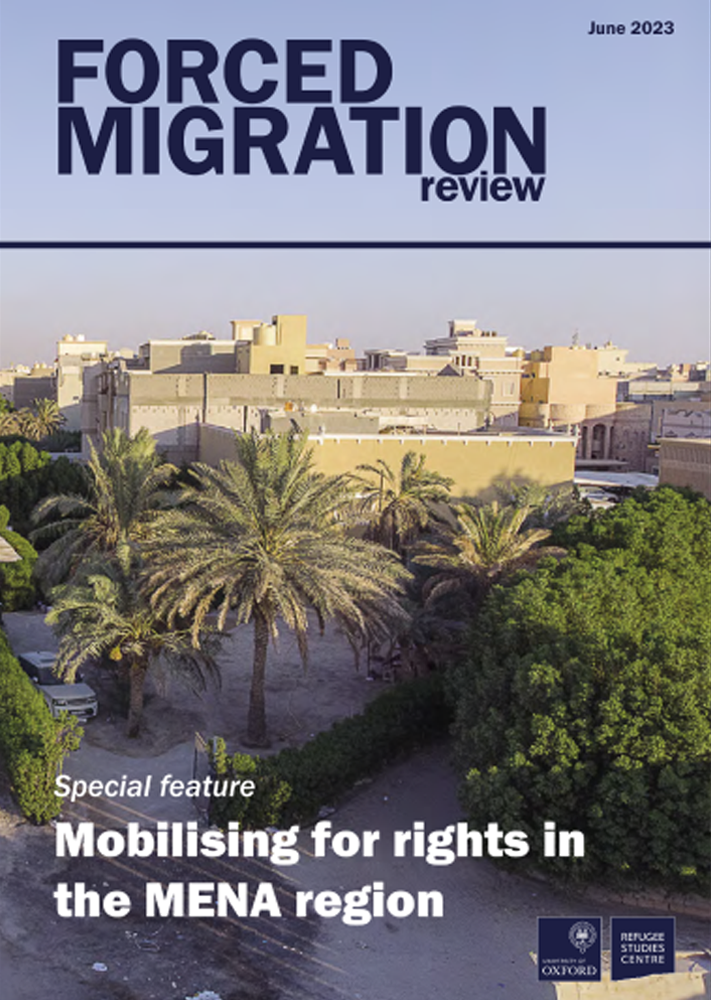
Introduction: Rights mobilisation in the Middle East and North Africa region
In this special feature, a range of authors examine how localised or transnational acts of mobilisation can support the rights of forced migrants in the Middle East and North Africa region.
Palestinian women of Syria mobilising to influence knowledge production
The voices of Palestinian women of Syria are often silenced in knowledge produced in humanitarian research and practice. ‘Speaking back’ sessions provide crucial insights into these women’s experiences and their relevance for discussions on rights mobilisation.
Refugee mobilisation to support refugee rights in Jordan, Lebanon and Turkey
Refugee-led initiatives supporting refugee communities in the Middle East have developed in different ways in response to an often restrictive policy environment. The international humanitarian and research communities should acknowledge the capacity of these initiatives and find ways to listen to, learn from and collaborate with them more effectively.
Addressing statelessness in the MENA region: a new network for mobilisation
A new regional network on statelessness in the Middle East and North Africa region is raising awareness and providing a platform for mobilisation.
Freedom of movement activism in the Sahara
Activists in the Sahara have mobilised to protect the rights of migrants to mobility and safety during their journeys to North Africa but they face significant challenges in a hostile political environment.
Mobilisation: a mode of survival for overlooked minority refugees
Minority refugees and their supporters in Jordan have tried to address the unmet needs of their marginalised communities through daily acts of resistance and informal network-building efforts.
Community-centred legal aid: strengthening protection and access to rights for refugees
A local service provider in Cairo has been partnering with refugee-led organisations to develop a decentralised network of community-based legal services in order to better protect refugees’ rights, while also working to promote the inclusion of refugees in broader decision-making processes.
Socio-economic integration: towards solutions for displaced people
Launch event for FMR 71 ‘Socio-economic integration: towards solutions for displaced people’
FMR 71 – Socio-economic integration: towards solutions for displaced people
The quest for socio-economic integration, for both forcibly displaced people and host communities, raises fundamental questions for all those involved in forced migration policy, practice and research about how displaced people can live with autonomy and dignity.
The authors in FMR 71 share new perspectives on socio-economic integration that we hope can lead to a concrete and transformative shift in approaches. They reimagine the role of integration in responses to displacement, at a significant time of global change marked by the COVID-19 pandemic, urgent climate-related pressures and ongoing digital transformation. Most importantly, this issue includes displaced people’s voices and strategies in working towards solutions.